
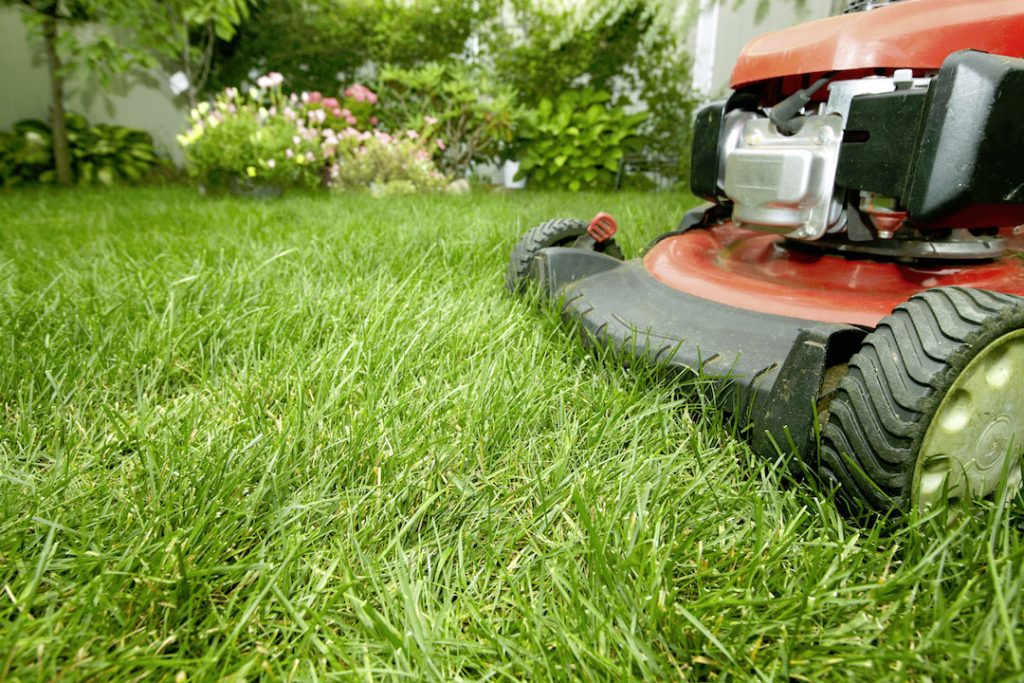
Mowing lawns without a catcher has many benefits, and a few drawbacks as well, but like all things – there is usually a balance to be found in moderation.
Unlike other Aussie lawn types, Buffalo grass will require very special consideration when mowing without a catcher and letting the clippings fall back into the lawn.
Benefits of Mowing Buffalo Without a Catcher

Nitrogen Feeding
One of the main benefits of mowing without a catcher is that the clippings contain high amounts of Nitrogen, a major element in all lawn fertilisers, and a nutrient which lawns require more than any other.
So when mowing without the catcher and leaving the clippings to fall back into the lawn, we are feeding the lawn in a small way with no extra effort or expense on our part.
Added Moisture
Lawn clippings will also contain small amounts of moisture which can keep the top of the lawn moist, as well as the clippings providing a thin layer of protection between the soil and the open elements, thus reducing soil moisture evaporation.
Main Drawback of Mowing Buffalo Without a Catcher

Thatch Build-Up
The downsides of mowing a lawn without a catcher are that the lawn can build-up thatch more quickly, and can become more prone to disease or pest infestation if the process is not done properly, and monitored.
This should be kept in consideration for most lawn types, however, it is particularly important to keep this in mind when mowing Buffalo grass. Buffalo grass is well known for its thick top layer of stolons (above ground runners), which is an inherent trait for all Buffalo grasses, including the new soft varieties. This thatch layer can grow quite quickly and high.
Now we can imagine if we mow a Buffalo lawn without a catcher, then these same clippings are going to fall into this thick thatch layer which is unique only to Buffalo grass.
Two Reasons Thatch Buildup will Hinder a Buffalo Lawn
Firstly, we will be adding to the thickening growth of this thatch layer at greater speed, which is one of the worst things we could possibly do with a Buffalo lawn.
And secondly, if the Buffalo grass lawn has already developed that thick layer of thatch, the new green lawn growth will have difficulty sending its roots down into the soil, and many of the roots will remain in the old decaying thatch beneath it.
By putting more clippings into this thatch layer, the roots of the new green turf on top will root themselves very firmly inside this dense mat of nutrient-rich thatch and stay there, without proceeding into the soil itself.
What Thatch Buildup Causes
This is a major problem on many fronts for Buffalo grass. First, is that the thatch, even with decaying lawn clippings, does not contain the nutrients necessary for good lawn health, so the health of the Buffalo lawn will suffer. And secondly, the thatch layer will dry out very quickly in the summer sun, leaving the Buffalo lawn needing far more water, than normal, to survive.
Therefore mowing Buffalo without a catcher is really not a good idea. Of course, we could go on further with more examples, but above are the main drawbacks you could face.
When to Mow Buffalo Grass Without a Catcher
Sometimes we can indeed mow Buffalo grass without a catcher, and leave the clippings where they fall, and the turf will improve beneficially as a result.
The best time and the only time to mow Buffalo grass without a catcher is when there is no danger of that thick Buffalo thatch layer growing into the turf.
If your Buffalo Lawn is Thin
This can be under a few different circumstances. If the Buffalo lawn is not being kept in the best of health and is rather thin on the ground, then mowing without a catcher will be fine. This is because the clippings will return their Nitrogen and moisture and some organic matter back into the soil for the benefit of the Buffalo turf.
If your Buffalo is Grown in the Shade
Also, Buffalo grass is much less prone to severe thatching when grown in the shade. In fact, many Buffalo lawns can go on for years and years growing in partial shade without ever-growing this thick thatch layer.
So if your Buffalo lawn is growing in partial shade and is not showing signs of developing a thick thatch, then, by all means, mow the lawn sometimes without the catcher and without fear.
New Buffalo Grass Lawns

We should also stress that these factors relating to mowing Buffalo grass without a catcher also apply to new Buffalo lawns. Especially those being grown in full sun conditions.
What to Lookout For
New Buffalo lawns can appear to not have too much of a thatch layer developing, and the homeowner must be aware that this will usually only be a temporary situation.
All Buffalo lawns will slowly grow their thatch layers over time, especially if these new lawns are being kept in good health and being grown in full sun.
Therefore the homeowner needs to be careful not to mow their new Buffalo lawn without a catcher either, despite the fact that it may seem as though there is no risk of thatch developing. Instead, they should be mindful of the problems of thatch, knowing that it will eventually come to their lawns too, and not to make the problem worse any sooner than it need be by mowing without a catcher.

 Shade
Shade Maint.
 Drought
 Wear
Wear $12–$18/m²