
Common Causes
- Heavy rainfall
- Heat
- Humidity
- Over watering
- Incorrect lawn management
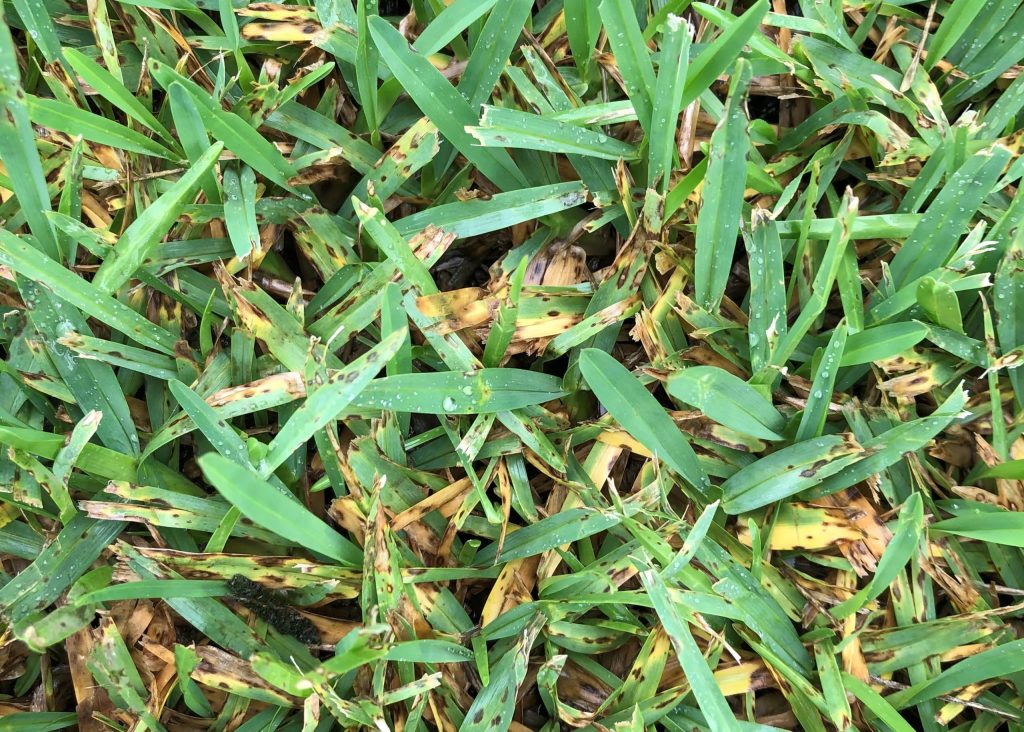
 Black Spot is characterised by black spots on the upper side of your lawn’s leaves and occurs due to fungal diseases such as Leaf Spot, Pythium Blight, Leaf Smut and Slime Mould.
These black spots not only look unattractive and serve as an eyesore, but they also sabotage the health and vigour of the lawn and weaken its structure.
Black Spot can infect all grasses, both warm and cool season varieties.
During warmer weather, massive deluges combined with heat and humidity create the ideal conditions for Black Spot.
General Symptoms

- Leaf blades with reddish-black to purplish-black spots
- Mould-like masses on the lawn
- Cobweb-like growths of fungi are usually apparent during humid, wet mornings or evenings
Treatment
Black Spot does require immediate attention to control spread and to aid the grass in regaining its health and natural colour. A range of management controls is recommended for lawn owners which are suitable across a broad range of fungal diseases prior to using a fungicide.
Step 1. Check Lawn Care Management
These include:

Watering
Avoid over-watering your lawn, particularly in shaded areas to prevent Black Spot.
Shade prevents the quick evaporation of dew or surface water and continued dampness will encourage Black Spot.
Water in the early morning, deeply but less frequently, to encourage stronger roots and to allow the water to absorb properly and the grass to dry-off.
Fertilising
Over applying fertiliser or under applying to nutrient deficient soils can promote Black Spot.
Speak to your Local Garden Centre for advice on how much fertiliser to apply to your particular lawn variety.
Remove thatch
 While thatch, such as dead organic material, is a natural and beneficial part of all lawn, it becomes a real problem when it increases to excessive amounts.
Dethatching prevents waterlog in your roots and allows proper drainage, this will help to prevent the risk of Black Spot.
Aeration
Aeration will improve your lawns ability to absorb water, nutrient and oxygen which will help your lawn stay healthier.
Step 2. Fungicide application
 If lawn management does not work, then you will need to apply a fungicide to kill the fungi and the spores within the soil or lawn.
It is important that you first identify the specific fungal disease causing the Black Spot, such as Leaf Spot, Pythium Blight, Leaf Smut and Slime Mould, so the correct steps to rectify and eradicate the disease can be made. This can be done by taking a sample to your local Garden Centre.
Mancozeb is a trusted protectant fungicide that controls a wide range of diseases like Powdery Mildew, Dollar Spot, Rust and Black Spot.
 For best results and the eradication of Black Spot, a complete spray of the entire lawn is recommended.
For more information on specific fungal diseases and how to treat them contact your Local Garden Supplier.
 Shade
Shade Maint.
 Drought
 Wear
Wear $12–$18/m²